
When we talk about young people in Aotearoa, the conversation often begins with problems. Pressure points, statistics, trends that point in the wrong direction.
But alongside the challenges sits something just as real – the capacity for change.
Young people are optimistic – in New Zealand, that presents a real opportunity for us to realise.
Young people are not defined by the difficulties they face. They are shaped by what surrounds those difficulties: the environments, relationships, and experiences that either compound pressure or begin to shift it. At the Graeme Dingle Foundation, we focus on that shift through our programmes.
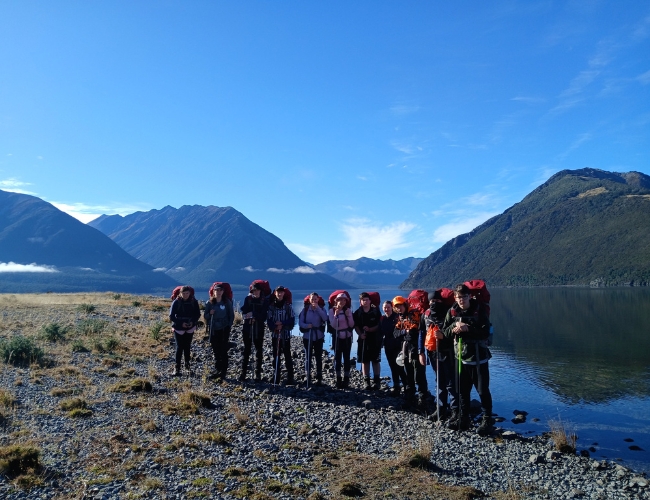
We think of those challenges as mountains, internal obstacles. With that metaphor in mind, the question is not simply how steep these mountains are. But rather, what it takes to move them.
The evidence is increasingly clear that change does not come from a single moment of intervention, but from a series of reinforcing conditions over time. Change is interconnected and impacted by many sources.
It starts early. Long before the outcomes become clearly visible.
In the early years, it is about how children learn to relate to themselves and others. Whether they can manage frustration. Whether they feel safe to try, fail, and try again. Whether they begin to understand how to navigate difference, build friendships, and stay engaged when things are difficult.
Later, it becomes about belonging. About identity. About whether a young person feels they have a place in their world and a future within it.
And beyond that, it becomes about direction – the ability to see pathways, make choices, and move forward with confidence rather than uncertainty.
Across all of this sits a consistent pattern in the research: when young people experience connection, consistency, and belief from the adults and systems around them, their trajectories change.
This is where the Graeme Dingle Foundation works – not at the point of crisis, but at the point of formation. Our programmes are deliberately structured as a connected journey that aligns with key stages of development.
Kiwi Can, delivered in primary schools, focuses on the foundations that shape lifelong learning and behaviour: emotional regulation, resilience, empathy, and cooperation. These are not abstract values. They are practised behaviours that influence how children respond to challenge, conflict, and opportunity in real time.
As young people grow, Stars supports transition and belonging, strengthening social connection during a period when disengagement often begins to emerge.
Career Navigator focuses on clarity and future pathways, with strong reported outcomes in confidence, employability skills, and direction. Wonderful mentors from around the country provide real opportunity and inspiration for our young people.
And Project K provides structured re-engagement for young people who are struggling with confidence, motivation, or direction – helping rebuild self-belief through experience, challenge, and supported reflection.
Together, these programmes form more than a sequence of initiatives. They form a system of support that meets young people at different points in their journey, before challenges become entrenched.
The impact is measurable. Independent evaluation shows that for every $1 invested in the Foundation, $10.50 is returned to New Zealand society through improved education outcomes, reduced justice costs, and stronger employment pathways.
But the deeper value sits beyond economics.
It sits in what becomes possible when a young person begins to experience themselves differently – not as someone facing an insurmountable climb, but as someone capable of moving forward.
Recent national research shows that young people in Aotearoa remain highly aspirational, even while experiencing lower levels of connection and opportunity than older generations. In other words, belief is not the issue. The issue is whether that belief is met with structure, support, and pathways that make it real.
That is the space the Graeme Dingle Foundation operates in.
Not replacing aspiration – but strengthening it and providing a pathway forward. Or, at least, making that pathway easier to see. Not reacting to difficulty – but shaping the conditions that prevent it becoming defining. Not focusing on single moments – but building over time.
Because moving a mountain is rarely about force.
It is about structure. Consistency. Early intervention. And the presence of people and systems that help carry the weight long enough for momentum to build.
And when that happens, what once looked immovable begins to shift.
Not quickly. But meaningfully.
And for a young person, that shift changes everything.
Donate today and support the work of the Graeme Dingle Foundation. Help us move those mountains we cannot see.