
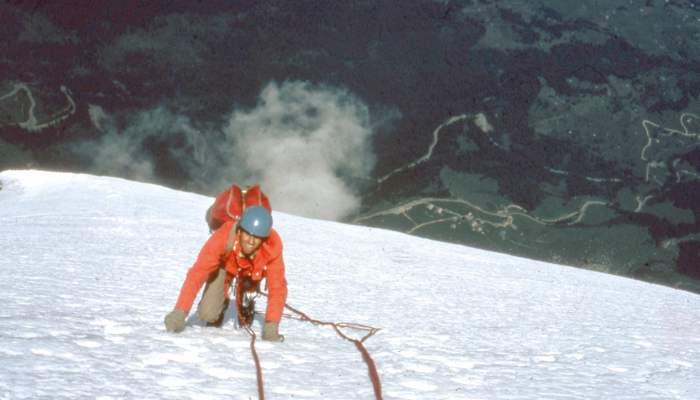
In 1969, Graeme Dingle and Murray Jones became part of a world first, climbing all six of the classic great north faces of the European Alps in a single season.
Among them stood the most feared of all: the North Face of the Eiger.
Even today, the Eiger carries an almost mythical reputation. A towering wall of dark limestone and ice rising above Grindelwald in Switzerland, the face had already claimed dozens of lives by the time Graeme and Murray arrived beneath it.
For Graeme, simply standing below it was overwhelming.
“The very name gave me the shivers,” he later wrote.
The night before the climb, Graeme met a Japanese climber who told him he was the only Japanese mountaineer to have successfully climbed the face. When Graeme asked if he had climbed it solo, the climber replied:
“No. Near the top my friend fell and broke his leg, then he untied from the rope and threw himself down the face.”
That was the reality of the Eiger.
After sleeping in their van at Grindelwald, Graeme and Murray caught the rack railway toward the mountain early the next morning. They avoided attention at Kleine Scheidegg and quietly made their way toward the base of the wall.
Above them loomed 2,000 metres of steep rock, ice and danger.
“It felt a bit like a man who was about to be executed,” Graeme later recalled.
The pair climbed unroped at first, moving quickly across slabs and short walls beneath the immense face. But unlike many climbers before them, they approached the Eiger with a strategy.
They believed the mountain’s greatest danger was not necessarily the climbing itself — it was the constant stonefall. Rocks regularly tore down the wall, injuring or killing climbers caught exposed on the icefields below.
Their solution was simple but bold: climb the dangerous central section at night when freezing temperatures locked the loose rock in place.
By afternoon they reached a ledge known as the Swallow’s Nest, sheltering beneath an overhang while stones screamed down through the mist around them. There they waited.
At 2am, in darkness and freezing cold, they set off again.
The gamble worked.
The stones were frozen solid into the mountain and the pair moved quickly upward through the icefields and steep ramps of the face. But as dawn broke and sunlight hit the summit above, the mountain immediately came alive.
A barrage of rocks came crashing down toward them.
Graeme dodged across the ice, while Murray, tied to an anchor, could only wait and hope.
They survived and pushed higher.
The route carried them through infamous sections of the wall, Death Bivouac, the Spider, and finally the Exit Cracks near the summit. It was here, high above the valley floor, that disaster nearly struck.
While attempting an overhanging crack system, Murray fell headfirst from the wall.
The rope snapped tight.
Graeme was slammed violently against the anchor, a tiny piton driven only millimetres into the rock. Somehow it held.
Below them, the Eiger dropped away for thousands of feet.
Miraculously, Murray survived the fall with only bruising, and the pair regrouped before continuing upward. Exhausted but determined, they eventually found easier ground and climbed out onto the summit icecap and into sunlight.
“We were soon on easier ground, and then on the icecap and into the life-giving sunlight as if reborn,” Graeme later wrote.
Their ascent of the Eiger North Face became one of the defining climbs of their European season and helped cement Graeme Dingle and Murray Jones as world-class alpinists.
But beyond the achievement itself, the climb represented something deeper, calculated risk, trust in your partner, staying calm under pressure, and continuing forward despite fear.
It was a test of resilience, judgement and courage, qualities that would continue to define Graeme’s life long after he stepped off the mountain.
Ready to move mountains? Click here to take the challenge and support our tamariki and rangatahi.