
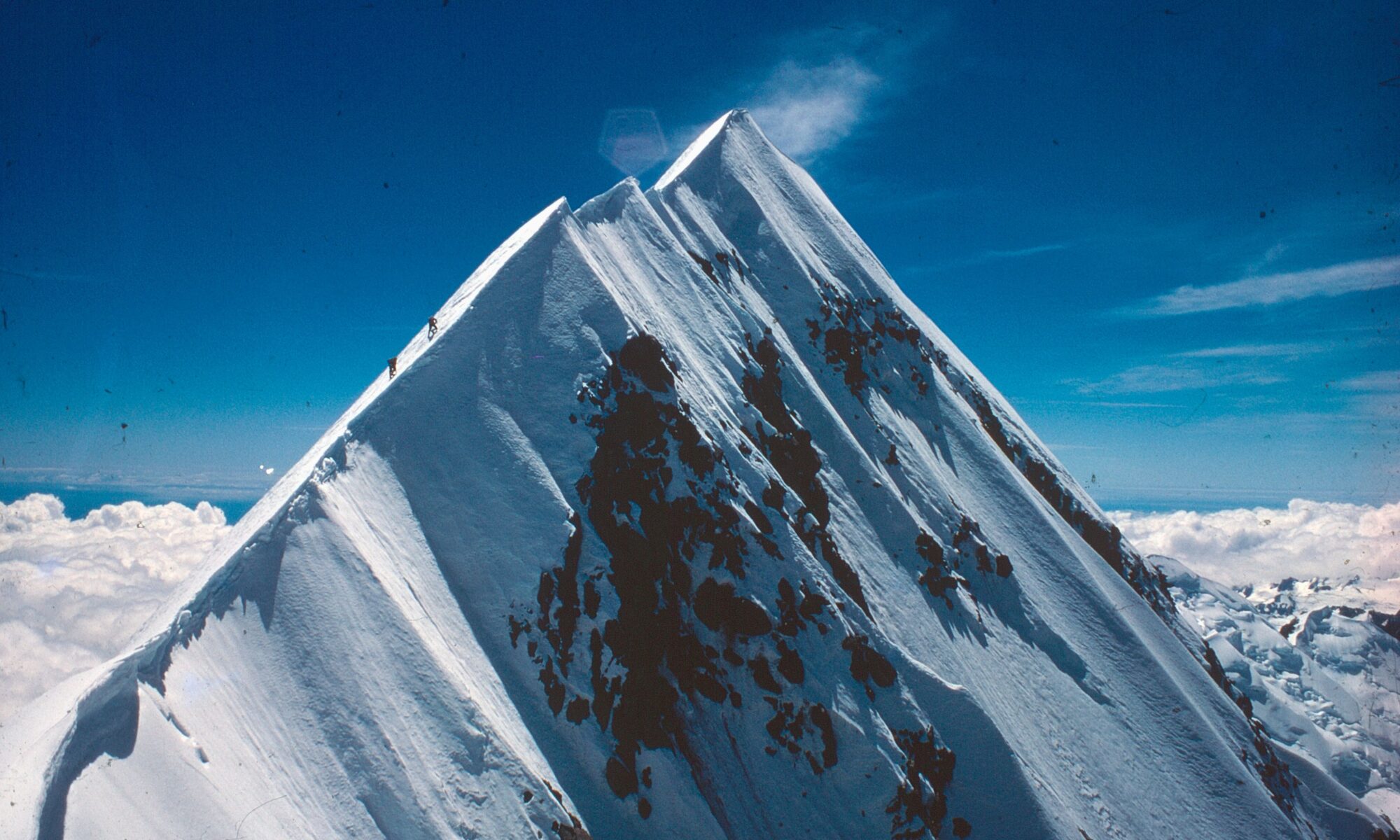
Towering above the surrounding mountains, Aoraki is New Zealand’s highest mountain, beautiful, unpredictable, and deeply respected by everyone who steps onto its glaciers and ridgelines.
For Graeme Dingle, it became far more than a summit. It became the mountain that helped shape his mountaineering career.
Graeme first climbed Aoraki / Mt Cook in 1966, beginning a relationship with the mountain that would span years of increasingly ambitious ascents and technical achievements.
Just a year later, in 1967, he completed a remarkable fast ascent of Zurbriggen’s Ridge, one of the mountain’s classic routes. Moving quickly through the night, the team reached the summit before sunrise and returned to the hut by 7 am, an extraordinary feat at the time and a sign of the climbing ability and endurance that would come to define Graeme’s era.
Over the following years, Sir Graeme continued to push into more difficult and technical climbs on the mountain.
In 1970, he completed the first repetition of the Caroline Face, a steep and serious alpine route that had only been climbed once before. At the time, the face was regarded as one of the most demanding climbs on the mountain, requiring technical precision and calm decision-making in exposed conditions.
In 1971, Graeme completed the Grand Traverse of Aoraki, an iconic alpine challenge involving multiple summits and complex ridge travel high above the glaciers below. That same year, he also guided the Linda Route, the mountain’s most well-known ascent line and still the standard route used by climbers attempting the summit today.
But perhaps one of the most significant achievements came in 1974 with the first winter ascent of the South Ridge.
Winter climbing in the Southern Alps brings an entirely different level of seriousness, shorter days, harsher storms, colder temperatures and far more unstable conditions. Completing a first winter ascent on Aoraki at that time was a major accomplishment and reflected the growing reputation of New Zealand climbers on the international stage.
These climbs were never simply about reaching the summit.
They were about preparation, trust, resilience and the willingness to keep moving forward in uncertain conditions. Long before satellite forecasts and lightweight modern gear, climbers relied on experience, instinct and each other.
The lessons Graeme carried from the slopes of Aoraki would go on to influence expeditions around the world and later, the work he would dedicate his life to through the Graeme Dingle Foundation.
Ready to move mountains? Click here to take the challenge and support our tamariki and rangatahi.