
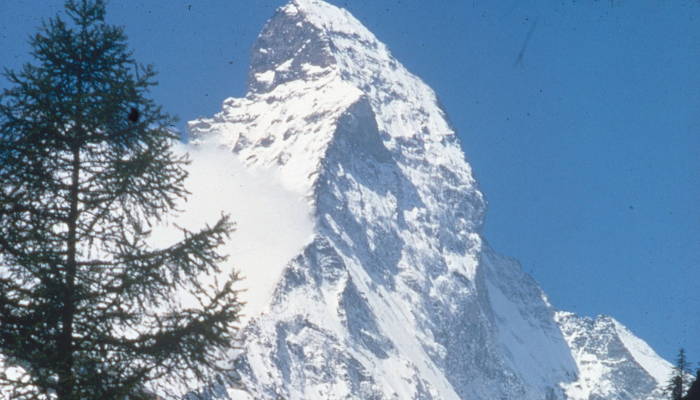
In 1969, Graeme Dingle and Murray Jones arrived in Europe with an ambitious objective to climb all six of the great classic north faces of the European Alps in a single season.
The first major wall on their list was the North Face of the Matterhorn.
Unlike the Eiger, which was feared for its deadly stonefall and dark reputation, the Matterhorn was famous for its striking beauty. Rising sharply above the alpine village of Zermatt, its near-perfect pyramid shape made it one of the most recognisable mountains in the world.
But Graeme quickly discovered the reality of climbing it was far less romantic.
“The Matterhorn is like a person who has perfect form from a distance, but close-up is repulsive,” he later wrote.
Travelling on almost no money, Graeme and Murray parked their van below Zermatt and caught the rack railway into the mountains. Without a tent or tourist accommodation, they searched for shelter and eventually settled into a hayrick on a grassy hillside beneath the mountain.
It was a simple beginning for one of the great alpine climbs of Europe.
When unsettled weather rolled through, the pair briefly travelled into northern Italy to visit legendary climber Carlo Mauri before returning for their attempt on the face.
The climb began quickly.
Still largely unacclimatised to the altitude, Graeme and Murray climbed the first third of the wall in just an hour without using a rope. But as they moved higher, the climbing became slower and more technical, steep rock coated in snow and ice with no clear route to follow.
The Matterhorn was not a mountain of obvious lines or straightforward movement. It was complex, loose and exposed.
By mid-afternoon, cloud drifted across the summit and swallowed the face around them. Snow began falling and visibility disappeared.
Soon they were completely lost beneath a huge overhang of dark rock.
Dangling above them was an old rope frozen into the ice. Murray managed to hook it with his piton hammer, but the rope looked dangerously rotten and appeared to be held in place by little more than ice itself.
“Do you think you can climb that?” Murray asked.
Graeme didn’t answer.
Instead, he committed himself upward onto the steep, ice-covered rock, fully aware that if he fell, there was little chance the anchor below would hold.
Then something shifted.
Graeme later described entering a rare mental state known by climber Lionel Terray as “divine madness” a moment of complete focus where fear disappears entirely.
For a brief period, the climb became instinctive.
Eventually, easier terrain led them onto the ridge roughly 100 metres below the summit. But unlike many modern alpine objectives, the summit itself was not their focus.
“The game was about the route, not the summit.”
As night fell, the pair carved a small ledge into the snow, pulled a bivy sack over themselves and spent the night high on the mountain before descending the Hörnli Ridge the following day.
The climb marked the first major success in Graeme and Murray’s historic European season.
Where the Eiger would later test them with objective danger and near catastrophe, the Matterhorn tested something different, judgement, composure and the ability to stay calm while completely off-route in worsening conditions.
Ready to move mountains? Click here to take the challenge and support our tamariki and rangatahi.