
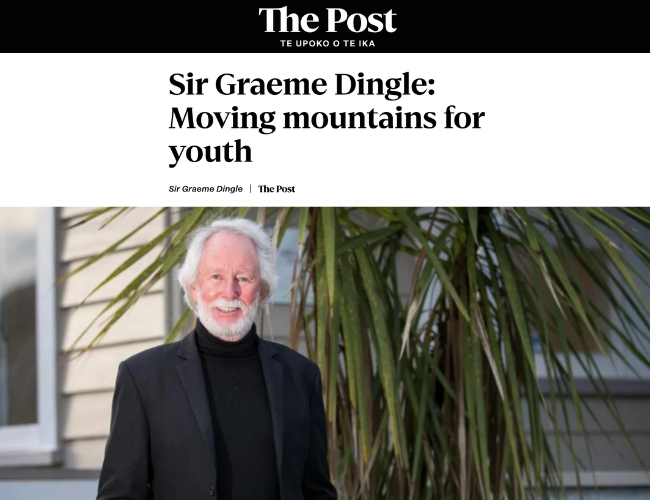
Originally published in the Sunday Star Times.
By Sir Graeme Dingle
Recently, we launched an initiative called Move Mountains for Youth.
The phrase felt right because, for many young people, the challenges faced today are not small hills; they are mountains. Truly. Some are visible; many are not. Internal mountains like confidence, identity, connection, and belief in self – these can be the hardest to climb.
The name is also, I am reminded by our hardworking team, a nod to my own climbing background. I would rather this not be about me, but if it helps frame the idea, so be it. Indeed, I have climbed many mountains in my life. But the one that has proved the most challenging is that of changing the trajectory of youth statistics in New Zealand.
When Jo-anne Wilkinson and I first began this work, youth outcomes in this country were already a concern. Decades later, they still are. While we have seen progress in some areas, we are still faced with deeply troubling indicators in others.
Over recent months, research reports have also painted a concerning picture. Rising isolation, ongoing mental health challenges, and too many young people feeling disconnected from purpose and belonging.
When we established our Foundation, we hoped for something simple but ambitious – that every young person in New Zealand would have the chance to discover their potential, no matter their starting point.
Our vision is that New Zealand is the best place in the world to be young. A place where all young people feel they have the opportunity to reach their potential.
Young people believe in their own potential. We just need to support them to realise it. Recent research from the Helen Clark Foundation shows they are our most aspirational and demographic. Aspiration is something to be protected, not lost.
The issue is not potential – it is pathways. Not taking responsibility for creating clearer pathways means we are collectively failing to meet the moment.
New Zealand’s future depends on what we do next.
The impact adults have on young people is something most of us understand through lived experience.
For me, it was a teacher at my intermediate school who first looked at a shy boy from Gisborne and said, “Graeme, you could be a great artist.” I remember thinking – wow, really? That simple act of belief changed how I saw myself. It opened up possibilities.
There were others who stepped forward at key moments and shaped the direction of my life in ways they could never have fully known. This is the impact humans can have on one another. Yes, even still – when robots are seemingly coming to rule the world.
I am now a long way from that shy boy in Gisborne. I am very happy with my life. I am proud of what has been achieved. But there is still work to be done.
Wealth and opportunity are not evenly spread across New Zealand. While we rightly debate cost of living, housing, and economic pressure, another truth sits alongside: we have more wealthy individuals in this country than ever before.
I know this view will not be universally held, but I have long believed that those who have benefited most from our society have a corresponding obligation to help strengthen its future. Not necessarily as charity, but as contribution – as a way of giving back into the system that enabled that success.
We are, quite simply, losing too many young people – through mental health struggles, disconnection, lack of direction and missed opportunity. Young people who never get the chance to step into what they are capable of becoming. That should not be acceptable to any of us.
We have an underutilised strength in this country: our older generations.
Wisdom and experience matters. Knowledge that comes from a lifetime of work, mistakes, resilience, and success is incredibly valuable. How can we use that to create clearer pathways for our young people?
It is not just money that supports young people. It is time, wisdom, encouragement, and presence.
At the Graeme Dingle Foundation, this is what we have been doing for more than 30 years.
We have supported more than 400,000 tamariki and rangatahi through our programmes. And the evidence shows it works. Return is not just financial – it is seen in wellbeing, in reduced harm, in stronger communities, and in young people who are better equipped to navigate life.
It can feel like there is not enough to go around. But the reality is, resources do exist. The question is how we choose to use them?
This question is urgent for New Zealand – and it is urgent for me personally. I don’t have as many years as I had at the outset of this mission, but I remain as committed as I have ever been.
If we want a stronger New Zealand, we must be willing to invest in the people who will build it. The young people of today.
That is how we will move mountains.
______
Sir Graeme Dingle KNZM, MBE and partner Jo-anne Wilkinson, Lady Dingle CNZM have dedicated over 45 years of their life to improving outcomes for Aotearoa’s young people. They are co-founders of the Graeme Dingle Foundation and recently launched movemountains.co.nz to drive support for their work.